Gender equality in hydropower

In the European Union (EU), women are underrepresented in the energy sector, making up only 24% of the total workforce. While the situation is slightly better in the renewable energy sector (32%), particularly compared to the oil and gas industry (23%), this figure remains significantly lower than the proportion of women employed in the overall economy (47%). In the hydropower sector in particular, women represent just 23% of the workforce.
Furthermore, women in the renewable energy sector tend to be concentrated in support roles rather than technical or decision-making ones. The highest share of female employees are in administrative roles (45%), followed by non-science, technology, engineering, and mathematics (STEM) technical roles (36%). Women are most underrepresented in senior leadership roles, holding only 19% of these positions. Their presence is somewhat higher in middle management, where they make up 26%.

Barriers restricting women’s participation, career progression, and long-term retention

Recognising the specific challenges that women face in the renewable energy sector is a necessary step towards creating effective solutions and enabling them to contribute fully to the energy transition.

These challenges are closely interconnected, but they can be grouped into three main categories:

  • Workplace barriers, such as biased recruitment practices and working conditions.
  • Societal constraints, including cultural and social norms and discriminatory laws and policies.
  • Barriers relating to skills, education, and professional development.

Workplace barriers

Although social expectations and disparities in education and skills development play a significant role in shaping women’s involvement in the workforce, workplace barriers linked to gender were identified as the most common challenges.
They include structural issues, such as the lack of family-friendly policies or gender targets; discriminatory practices, including biased hiring practices and hostile work environments, and practical constraints, such as inflexible work arrangements and rigid mobility requirements. Inflexible work arrangements include the lack of maternity and/or paternity leave, flex-time, home office or part-time work, and on-site childcare.
These barriers mean that while women and men are recruited for entry-level positions in nearly equal numbers, the proportion of women declines noticeably when it comes to the first step up the career ladder.

Societal constraints

Deep-rooted social norms result in cultural expectations for women that conflict with career choices and opportunities. One of them is the perception that hydropower and the energy sector in general are male-oriented.
The lack of visible role models also creates a challenge, as it becomes more difficult for others to picture themselves working in the field or to identify potential mentors within their organisations.
Additionally, women are more likely than men to receive critical feedback related to their personality, instead of constructive feedback. In the hydropower sector, they often receive less credit than their male colleagues, and the quality of their work is perceived as lower than their male colleagues.

Academic barriers

The most prominent barrier is the low number of women with STEM degrees, where on average only 20-30% of students are female. This percentage is even lower in engineering classes, which on average have 15-20% female students.
This lack of representation is also present in conferences and other events, where the majority of speakers are usually men. As a result, women might be more reluctant to attend events, which decreases their opportunities to network.
Another issue is the lack of awareness among women of opportunities in the hydropower sector, which are often disseminated through professional networks to which women have limited access.

Measures to address the barriers

The following measures, based on international evidence and sector-specific research, offer concrete pathways for improving women’s participation, retention, and advancement.

Measures to address workplace barriers

Organisations can establish gender-equality objectives at the highest decision-making levels to ensure leadership accountability, embedding gender considerations into business strategy. This includes adopting diversity and inclusion policies, conducting regular gender audits, and integrating equality goals into managers’ performance evaluations.

Recruitment processes should be transparent, competency-based, and free from gendered language. Employers can widen candidate pools by looking beyond traditional engineering profiles and engaging with women’s networks in the energy sector. Clear promotion criteria and regular pay equity reviews help to address persistent pay gaps and ensure equal remuneration for equal work.

Offering flexible working options, such as remote working, flexible schedules, job sharing, parental leave for all genders, and childcare support, reduces the burden of balancing work and care responsibilities. These measures are essential for improving retention rates and enabling women to advance in their careers without facing penalties for family duties.

Hydropower facilities often require work in remote locations. Companies can make these environments safer and more accessible to women by providing adequate facilities, properly fitted safety equipment, secure accommodation, and safe reporting mechanisms for harassment or misconduct.

Mentorship programmes, women’s resource groups, sponsorship initiatives, and leadership training are effective tools for advancing women into decision-making roles. Guidance from experienced professionals can help women to navigate career barriers, expand their networks, and build their confidence.

Measures to address societal constraints

Sector-wide visibility campaigns can highlight the contributions of women in hydropower and reposition the industry as a viable and attractive career path. This could involve showcasing diverse female role models, sharing stories from the field, and challenging stereotypes that depict hydropower as a “male-oriented” or physically unsuitable profession.

Since men continue to occupy most leadership roles in hydropower, it is essential to involve them in gender equality initiatives. Training on unconscious bias and equitable leadership, combined with encouraging men to act as sponsors and vocal supporters of gender equality, can help to remove societal constraints.

Measures to address academic barriers

Exposure to science and engineering should begin in primary and secondary education. Outreach programmes, school partnerships, STEM clubs, and campaigns that counter gender stereotypes can help to spark early interest in technical subjects and normalise girls’ participation in STEM.

Scholarships, internships, and apprenticeships designed for women can increase their representation in hydropower-related disciplines. Gender-responsive teaching practices, inclusive classroom environments, and the presence of female faculty members also encourage women to join STEM programmes.

Programmes that bridge the gap between universities and the energy sector, such as joint industry–academia training initiatives, career fairs, site visits, and graduate programmes, help female students gain practical experience and better understanding of career opportunities in hydropower.

Ensuring gender-balanced panels, inviting female experts as keynote speakers, and promoting women’s research contributions can counteract the lack of representation that often discourages women from participating in academic and professional communities.

Gender equality in STOR-HY

STOR-HY is committed to gender equality. To this end, the project coordinator, the Universitat Politècnica de Catalunya (UPC), is implementing a Gender Action Plan to foster a gender-balanced leadership and evaluate and monitor the involvement of women and men in STOR-HY. The plan includes the following objectives:
  1. To strengthen the gender dimension in research and technological solutions
  2. To address gender imbalances in decision-making and leadership
  3. To enhance the visibility of female researchers
  4. To facilitate gender-sensitive recruitment and career development of female researchers and students
  5. To foster an inclusive project culture

These objectives will be achieved by implementing and monitoring of specific actions throughout the project’s lifetime. Examples of these actions include analysing the gender dimension of research and technological solutions, supporting women’s participation in industry events, promoting networking opportunities, and creating awareness campaigns.

According to STOR-HY’s initial gender balance assessment, 26% of participants are women, which is slightly above the industry average. In line with these trends, women represent 58% of administrative and communication roles.
References

Energy Sector Management Assistance Program (ESMAP). (2023). Power with Full Force: Getting to Gender Equality in the Hydropower Sector. The World Bank. https://www.esmap.org/Gender-and-Hydropower
García-Baños, C. (2025). Renewable energy: A gender perspective. International Renewable Energy Agency. https://www.irena.org/Publications/2025/Oct/Renewable-Energy-A-Gender-Perspective
Gareis, K., Dashja, E., Hüsing, T., Popov, P., Schulz, C., Pollitzer, E., Borchgrevink, H. M., Striebing, C., Schraudner, M., Voigt, N., Gorgels, S., Danne, C., Morales, O., Müller, I., Hausner, B., Badieijaryani, A.,  Gligurovska, E., and Dimanoska, M. (2024). Gender balance in the R&I field to improve the role of women in the energy transition. European Commission. https://doi.org/10.2777/8283
Hakhu, A., and Helgenberger, S. (2021). Green employment for women. Towards gender-inclusive renewable energy careers. Institute for Advanced Sustainability Studies. https://doi.org/10.48481/iass.2021.031
United Nations Industrial Development Organization (UNIDO) and International Center on Small Hydro Power (ICSHP). (2022). World Small Hydropower Development Report 2022. https://www.unido.org/WSHPDR2022
United Nations Women (UN Women). (2021). Call to action: Gender equality in the renewable energy industry. https://energia.org/document/call-to-action-gender-equality-in-the-renewable-energy-industry

2025 World Hydropower Outlook

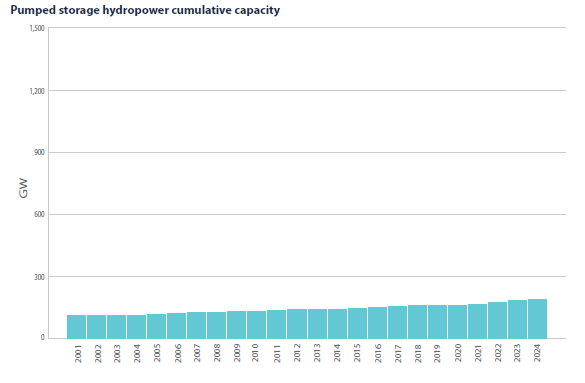
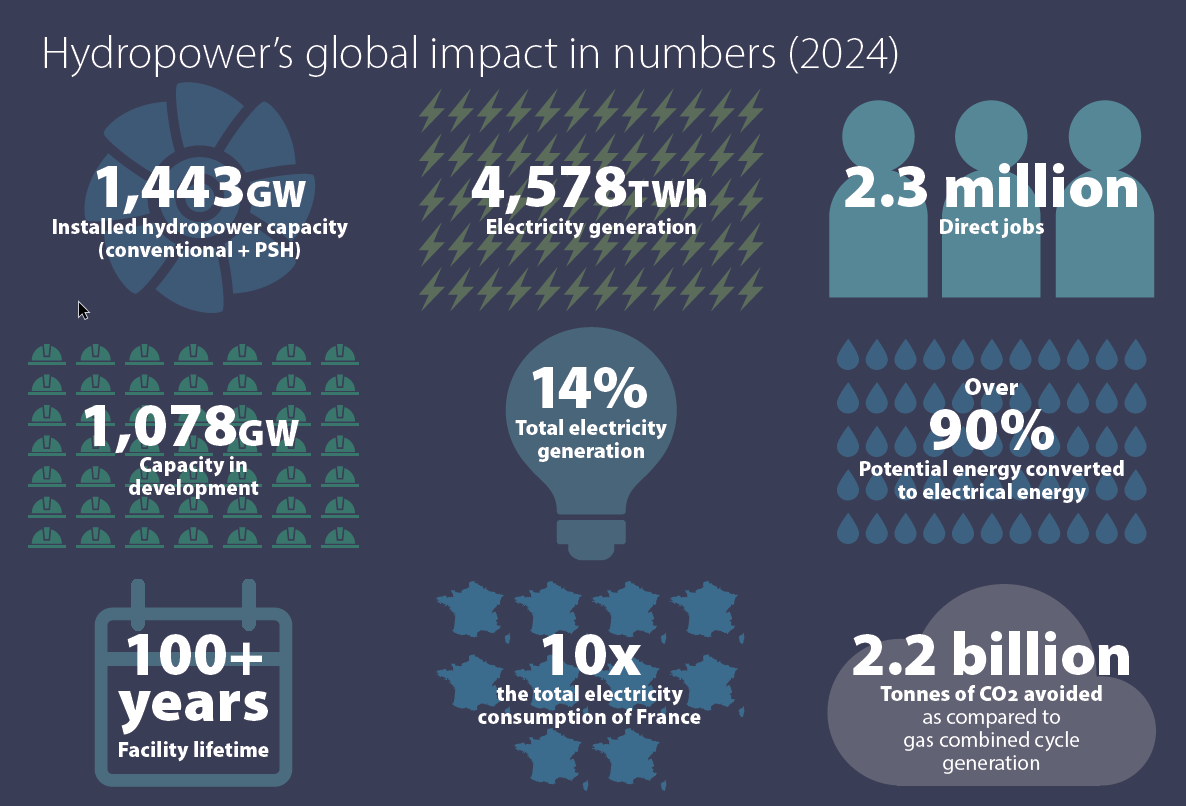
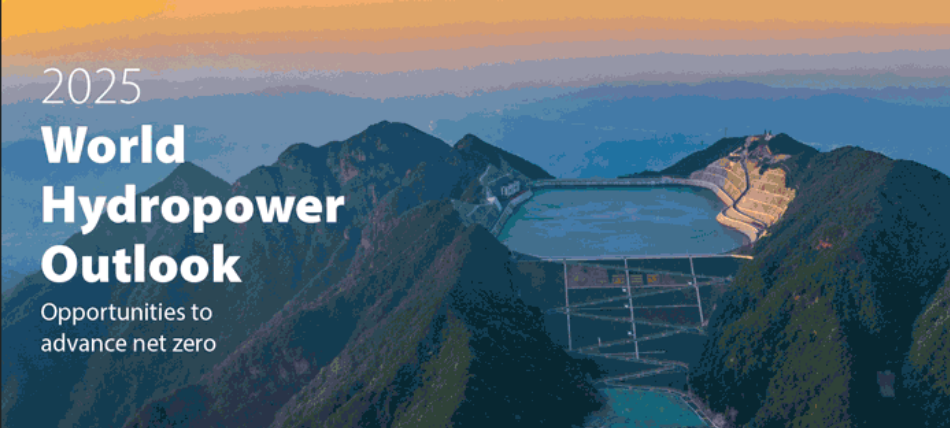
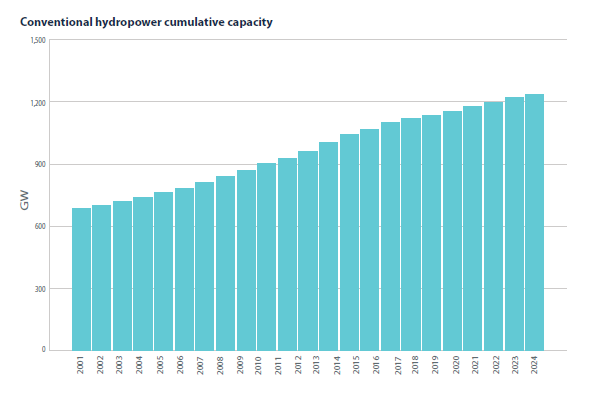
Last week, the International Hydropower Association (IHA) published the 2025 World Hydropower Outlook, which monitors the global development of hydropower. As the world accelerates its transition towards net zero, the importance of hydropower as a clean, flexible and reliable source of electricity is becoming increasingly recognised. Global hydropower generation increased by 10% in 2024, reaching 4,578 TWh. This included the addition of 16.2 GW of conventional hydropower and 8.4 GW of pumped storage hydropower (PSH), bringing the total global PSH capacity up to 189 GW, an increase of 5% from the previous year.

Source: International Hydropower Association (IHA). (2025). 2025 World Hydropower Outlook. https://www.hydropower.org/publications/2025-world-hydropower-outlook, p. 11
Source: IHA. (2025). 2025 World Hydropower Outlook, p. 11

A Surge in European Hydropower Momentum

The report reveals not only a global resurgence in hydropower development but also a particularly significant shift within Europe. 2024 was a landmark year for renewable energy sources, with frequent monthly peaks where hydropower, solar, and wind were the primary contributors to the EU power system. Due to exceptional precipitation, hydropower generation in Europe reached a decade high of 680 TWh, 13% higher than average production between 2014 and 2017. This peak performance highlights the importance of hydropower in the energy mix, as it provides the flexibility, reliability, and resilience required to support variable sources such as solar and wind.

Source: IHA. (2025). 2025 World Hydropower Outlook, p. 16

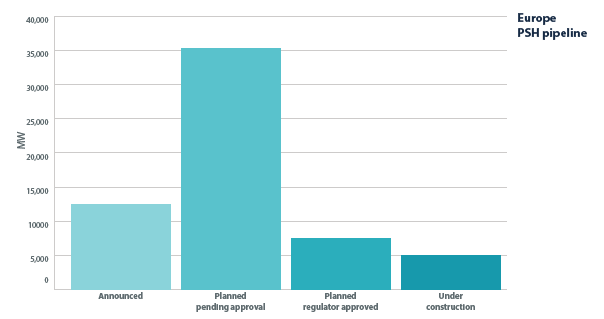
PSH, the most proven technology for storing electricity at scale, is emerging as a major growth area. A total of 187 MW of PSH capacity was added in 2024. With 52.9 GW in the pipeline, including 3 GW under construction and 6.7 GW already approved, PSH is becoming increasingly attractive amid market volatility and system stress. Europe is capitalising on this momentum with over 60 GW of PSH projects in development, including STOR-HY.

Source: IHA. (2025). 2025 World Hydropower Outlook, p. 59

The countries in which the STOR-HY demonstrators are located are making promising advances. Portugal is the EU Member State that added more hydropower capacity (160 MW) in 2024, while Spain (22,747 MW) and France (20,385 MW) are among the top 10 European countries by total installed hydropower capacity, in the third and fifth position respectively.

Source: IHA. 2025 World Hydropower Outlook, p. 63

Flexibility in the Age of Volatility

Europe’s electricity market is undergoing profound changes. The increasing frequency of negative electricity pricing–over 1,000 hours in the first eight months of 2024 alone–reflects a system that is oversupplied during off-peak renewable surges. PSH offers a critical solution by absorbing excess electricity and releasing it during periods of high demand, while also providing essential ancillary services such as frequency control and inertia.

However, the market alone cannot sustain the required pace of hydropower development. The Outlook emphasises the need for policy reform, long-term investment signals and streamlined regulation to ensure that storage projects are both viable and timely. Thanks to integrated power markets and strong policy frameworks such as the Green Deal and REPowerEU, Europe is well positioned to lead this reform.

Climate Resilience: An Increasing Priority

Europe is already experiencing the effects of climate change. Southern European countries, including Italy, Spain, and Türkiye, are expected to see a decline in hydropower generation of up to 40% by the end of the century due to changing rainfall patterns and increased evaporation. This underlines the importance of not only increasing hydropower capacity, but also of developing smarter, climate-adaptive hydropower systems.

The modernisation and digitalisation of existing plants, including the implementation of real-time monitoring and advanced turbine technologies, are essential for realising this potential. As the report highlights, almost 40% of the global hydropower fleet is over 40 years old, so upgrades are essential to maintain performance and meet new demands for flexibility.

Hydropower’s Role in a Sustainable European Future

Hydropower remains Europe’s most proven and scalable form of long-duration energy storage. It is uniquely positioned to support the continent’s dual challenge of decarbonising energy systems and maintaining grid stability in the face of increasing renewable energy penetration and extreme weather events.

With the Global Energy Storage and Grids Pledge aiming for 1,500 GW of energy storage by 2030, hydropower, especially pumped storage, must play a central role. Europe’s leadership in this area is crucial in setting an example of how modern energy systems can align climate goals with resilience and affordability.

StorHy Logo
Privacy Overview

This website uses cookies so that we can provide you with the best user experience possible. Cookie information is stored in your browser and performs functions such as recognising you when you return to our website and helping our team to understand which sections of the website you find most interesting and useful.