UT and STOR-HY
The University of Twente (UT), located in the Netherlands, is a leading research university integrating engineering, technology, natural sciences, and social sciences to address global and regional challenges. With over 12,000 students from around the world and more than 4,100 staff members, UT fosters an international and interdisciplinary research environment.
Within the Faculty of Engineering Technology at UT, the Department of Civil Engineering and Management hosts the Multidisciplinary Water Management (MWM) group, specialising in water resources management, sustainability assessment, and decision-support modelling and research.
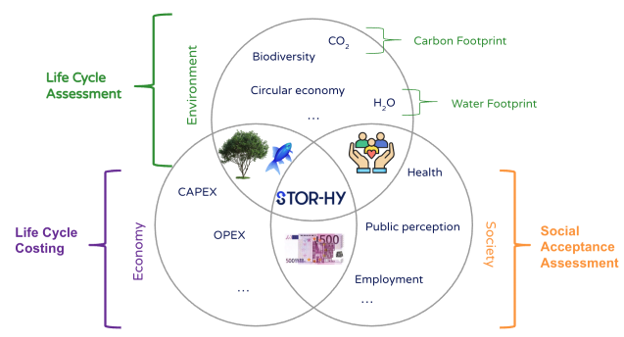
In the STOR-HY project, the MWM research group at UT leads Work Package 7 (WP7) on integrated sustainability, developing a comprehensive sustainability framework to assess the environmental and economic performance of the innovative technologies across the demonstration sites. Specifically, the UT team is responsible for conducting life cycle assessments, biodiversity impact assessments, circular economy evaluations, and life cycle costing analyses. Through these activities, UT aims to quantify environmental impacts, assess the effects on aquatic and terrestrial ecosystems, evaluate resource efficiency and material circularity, and analyse economic performance in collaboration with other consortium partners in WP7.
Contribution to STOR-HY
Within the STOR-HY project, UT is actively involved in the following key activities:
- Life Cycle Assessment (LCA): This activity quantifies environmental impacts (e.g., climate change, water use, and resource depletion) and evaluates the benefits of STOR-HY innovations using system thinking and life cycle perspectives.
- Biodiversity Assessment: This activity evaluates the impact of pumped storage hydropower construction and operation on terrestrial and aquatic ecosystems, considering drivers such as land use change, climate change, and pollution through LCA-based indicators.
- Circular Economy Assessment: In this activity, we assess circular economy potential in terms of material efficiency, reuse and recycling, using circularity indicators and material flow analysis in relation to the environmental performance of pumped storage hydropower.
- Life Cycle Costing (LCC): UT is developing an LCC model to investigate long-term economic performance, including capital, operational, refurbishment, and decommissioning costs, as well as levelled costs of electricity and storage.
The final deliverable of WP7 will incorporate the findings from these assessments, along with the social components from our consortium partner (NORCE), into the development of Life Cycle Sustainability Assessment (LCSA) framework. This integrated framework identifies trade-offs and synergies across the life cycle stages of the demonstrators, providing science-based guidance and decision-support tools to ensure the sustainability of the demonstrators in the STOR-HY project.
Rethinking the assessment approach for greenhouse gas emissions from pumped storage hydropower projects
Greenhouse gas (GHG) emissions are the primary driver of climate change, which is increasingly recognised as a major threat to biodiversity worldwide. Rising temperatures and more frequent extreme weather events resulting from the accumulation of GHGs in the atmosphere can disrupt habitats, alter ecosystem functioning, and accelerate biodiversity decline. As countries expand their renewable energy systems to mitigate climate change, it is essential that GHG emissions are accurately accounted for in order to ensure that climate benefits are fully realised and environmental trade-offs are identified.
During the operational phase, GHG emissions from pumped-storage hydropower arise from two main sources. The first is direct emissions from reservoirs, including methane and carbon dioxide released from flooded land and aquatic ecosystems. The second is indirect supply-chain emissions, particularly those associated with the electricity consumed during pumping operations. Since pumped-storage hydropower relies on grid electricity to pump water to an upper reservoir, its carbon footprint depends strongly on the carbon intensity of the electricity mix.
Current assessments that use conventional LCA approaches typically rely on static inventory data for electricity grids and reservoir emissions. However, this conventional static LCA approach is limited in its ability to represent the variations in GHG emissions that occur throughout the lifespan of pumped-storage systems, which often operate for many decades. This can sometimes result in the overestimation of the GHG emissions from pumped storage hydropower.
Our research team at the University of Twente is addressing this challenge by developing and applying a time-explicit LCA approach for the specific context of pumped-storage hydropower systems. By incorporating temporal variations in electricity generation mixes and reservoir emissions, this method provides a more accurate representation of GHG emissions throughout the operational lifetime of pumped-storage hydropower systems. This is particularly important as electricity grids continue to decarbonise and reservoir emissions change over time.
This new approach will help policymakers, developers, and operators to better understand the long-term climate performance of pumped storage hydropower and its potential environmental impact on global and local biodiversity, thereby supporting more informed and sustainable planning decisions.
Conclusion
UT’s participation in STOR-HY reflects its commitment to enhancing the sustainability of future energy storage systems through scientific innovation and interdisciplinary research. By leading the project’s integrated sustainability assessment activities, UT is developing and applying improved methods, new scientific approaches and indicators, and decision-support frameworks to quantify the environmental, biodiversity, circular economy, and economic performance of pumped-storage hydropower systems. In doing so, UT is helping to improve the understanding of the long-term sustainability trade-offs and opportunities associated with hydropower operation and refurbishment. These contributions aim to support evidence-based decision-making and enable the development of more sustainable, resilient, and environmentally responsible pumped energy storage solutions within the STOR-HY project and beyond.