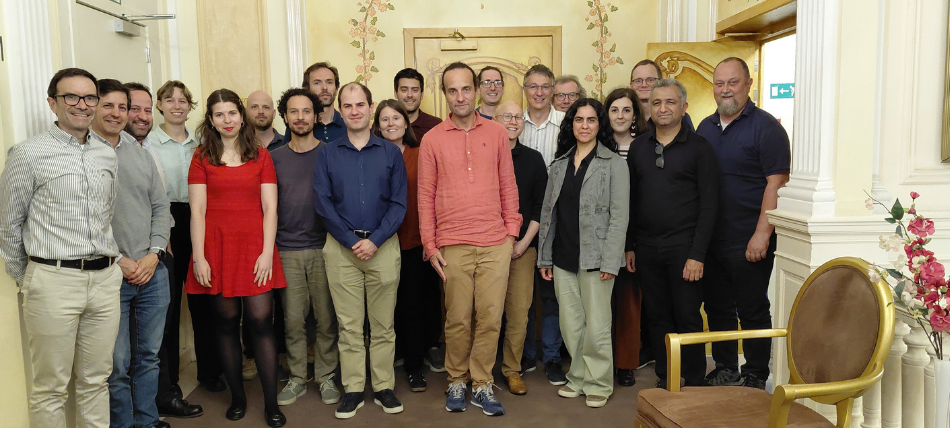
On 3–4 June 2026, the STOR-HY consortium convened in Brussels for its fourth consortium meeting and first review meeting, bringing together project partners, the Project Officer from the Climate, Infrastructure and Environment Executive Agency (CINEA), an external reviewer, and one of the Chairs of the International Advisory Board. This two-day event offered the chance to evaluate progress made during the initial reporting period, discuss ongoing activities and define priorities for the next phase of the project.
Reviewing progress across the project
The meeting opened with a presentation by project coordinator Alexandre Presas Batlló (Universitat Politècnica de Catalunya), who provided an overview of the project’s achievements to date. At month 18, STOR-HY remains on track to deliver innovative pumped storage hydropower solutions, having submitted 16 deliverables, published several scientific publications, and developed a growing portfolio of communication and stakeholder engagement activities.
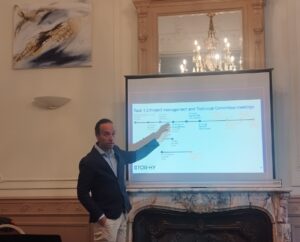
Partners then presented progress across all work packages.
WP2 reported advances in defining the technical, economic, environmental, regulatory, and social requirements for future pumped storage plants through the development of the STOR-HY matrix, which was presented in a workshop last July. Significant progress has also been made in defining business use cases for all demonstrators and developing methodologies to assess social acceptance and environmental performance.
WP3 showcased developments in advanced monitoring technologies and the Cyber-physical platform for Advanced Decision Support (CADS). Monitoring systems are already operational at several demonstrators, while work continues on virtual sensors, predictive maintenance strategies, CFD and FEM models, and the cloud-based CADS platform that will support operational decision-making.
WP4 presented progress on innovative control and operational management strategies for pumped storage plants. These activities included developing advanced control algorithms, optimisation tools for energy management and ancillary services, battery sizing methodologies, and concepts for hybridising hydropower with batteries and photovoltaic systems.
WP5 highlighted advances in technologies for harsh operating environments and saltwater applications. Partners reported progress on their work with anti-corrosion coatings, biofouling mitigation solutions, sediment monitoring technologies, and studies exploring the future potential of saltwater pumped storage hydropower in Europe.
Demonstrating innovation in real operating environments
A key focus of the meeting was WP6 and the project’s demonstrators, which are essential for validating STOR-HY technologies under real operating conditions. Updates on the demonstrators at Vouglans–Saut Mortier–Coiselet, Le Cheylas, La Rance, Alqueva, and Vilarinho das Furnas were presented. The activities presented ranged from advanced monitoring campaigns and wear-and-tear assessments to biofouling mitigation, hybridisation studies, and innovative operational strategies for increasing flexibility.
Sustainability, exploitation, stakeholder engagement, communication and dissemination
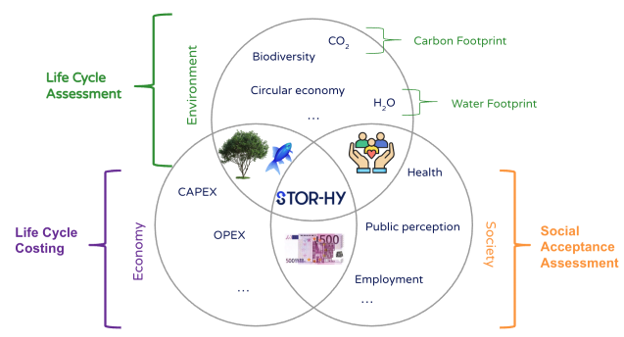
Progress was also reported on the project’s sustainability activities. WP7 presented initial results of the life-cycle assessment, biodiversity analysis, circular economy evaluation, life-cycle costing, and social acceptance studies. These activities will contribute to a comprehensive sustainability framework capable of evaluating the environmental, economic, and social impact of innovative hydropower solutions.
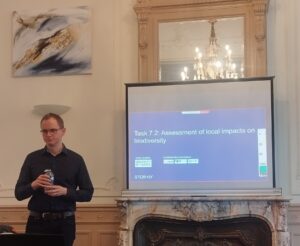
WP8 presented ongoing work to maximise the long-term impact of STOR-HY through exploitation planning, market analysis, and the identification of Key Exploitable Results (KERs). The first version of the project’s Exploitation Master Plan is currently being prepared to support the future uptake of STOR-HY technologies.
WP9 presented the progress achieved in stakeholder engagement, communication, dissemination, and training activities. During the first reporting period, the project launched its website and social media channels, published scientific papers and technical articles, organised public events and workshops, and strengthened collaboration with other European hydropower initiatives.
A successful first review
The second day of the meeting was dedicated to the review of the first reporting period. The consortium presented its achievements to the Project Officer and the external reviewer, who assessed the project’s progress against its objectives and planned activities.
The review was successful, and the consortium received positive feedback on the quality of the work performed. The reviewers recognised the project’s achievements and provided valuable recommendations for the next stages of implementation.
Having established a solid foundation established during its first 18 months, STOR-HY now enters the next phase of the project with a clear roadmap for advancing innovative technologies and operational solutions that will contribute to the future of pumped storage hydropower in Europe.
We would like to thank all the partners for their contributions, the International Advisory Board for its continued support, and the Project Officer and reviewer for their constructive feedback and guidance throughout the review process.