The La Rance power station in Brittany, France, one of STOR-HY’s demonstrators, is a large-scale tidal power station with a low tidal head, with 4-6 starts/stops per day. As part of WP 5, “Improved equipment for harsh operating fluids and saltwater environments”, partners EDF, Andritz, and GE Vernova are carrying out activities on this demonstrator with the aim of adapting tools to reduce maintenance costs in seawater environments (T5.2) and developing advanced sensing technologies to monitor water quality and the sedimentation of water particles (T5.4). The knowledge and techniques acquired, which are being compiled by Sener, the WP leader, will be then used in future saltwater pumped storage plant (PSP) schemes.
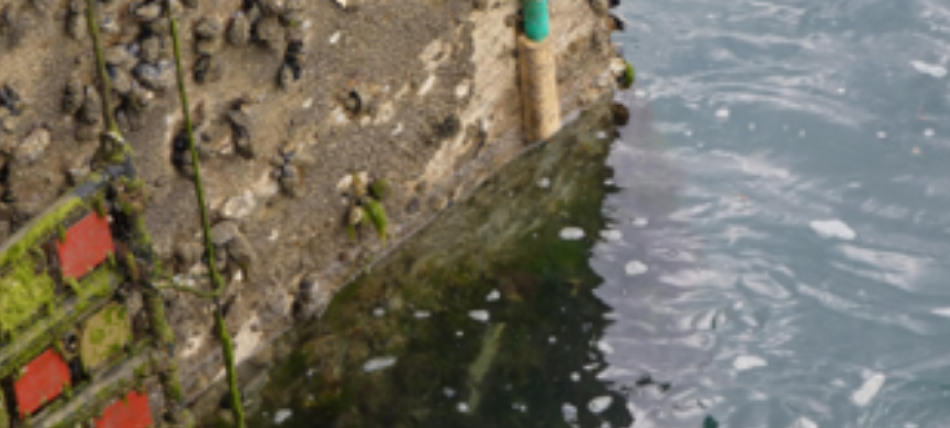
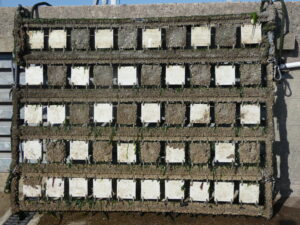
To limit biofouling and enable easy surface cleaning, the coupling of non-biocidal paints and soft cleaning systems are being tested at La Rance. Last year, colonisation coupon racks were installed at the station to analyse the impact of three different kinds of coatings: Bioclean (Chugoku), Hempasil 3X+ (Hempel) and Sigmaglide (PPG). These have all shown positive results, with some differences in the effect on wall colonisation, which consists mainly of barnacles, mussels and algae.
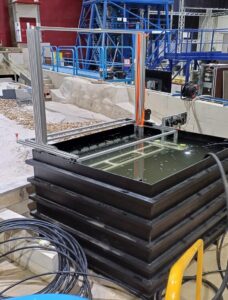
In addition, a cleaning system (Optostone) has been designed and constructed, and the first underwater trial of the system was performed last September. Such systems are employed to reduce the increased operational cost of operating hydropower in saltwater environments.
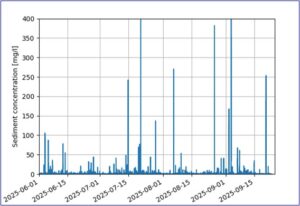
As part of task 5.4, the ultrasonic sediment sensor NivuParQ 850 by NIVUS was adapted for saltwater conditions. The sensor, which measures sediment concentration, was successfully installed in La Rance last May for testing. Since then, it has been remotely providing data that is being collected and analysed. First results indicate that sediment dynamics are influenced by the operation of the power plant. The sensor is also capable to distinguish five different classes of particle sizes.