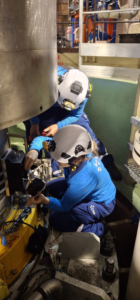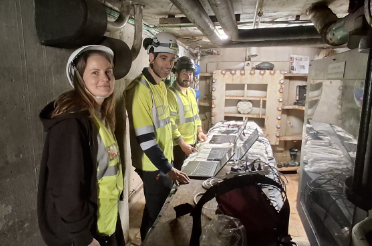
During the week of 31 August to 4 September 2026, tests were carried out on Unit 1 of the Cheylas pumped-storage power plant (EDF, Isère, France). Unit 1 was taken out of service for the entire duration of the testing campaign.
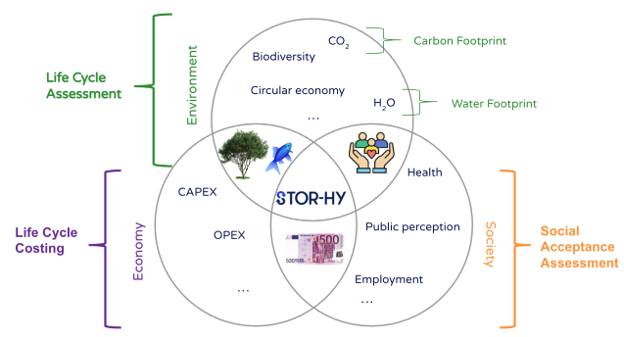
The main objective of STOR-HY at the Cheylas site is to identify the most suitable solutions for a pumped-storage hydropower plant (PSP) to meet electricity market requirements, particularly the transition to 15-minute production scheduling intervals. Within STOR-HY, EDF is also conducting additional activities at the La Rance and Vouglans/Saut Mortier sites.
The transition of the electricity spot market from hourly to 15-minute scheduling on 1 October 2025 aims to better manage rapid variations in electricity production and consumption, especially those associated with the growth of renewable energy sources such as solar and wind power. Two strategies can be considered to meet this new requirement: (1) increasing the speed of start-up and shutdown sequences to make them compatible with 15-minute market products, and (2) using synchronous condenser mode to extend 15-minute operating schedules. In this mode, the turbine remains rotating at its nominal speed between two 15-minute schedules, thereby complying with the recommended minimum operating and shutdown durations of 30 minutes.
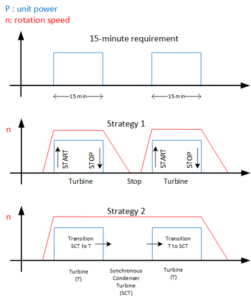
The objective of the tests performed at Cheylas was to evaluate the mechanical stresses experienced by the machine under different operating modes, in order to compare conventional start-up/shutdown sequences with rapid transitions between power generation mode (Strategy 1) and synchronous condenser operation (Strategy 2).
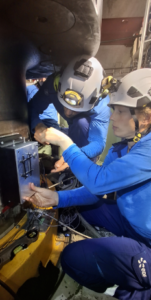
Flexibility is one of the key value-creating strengths of hydropower. However, this flexibility must be delivered using operating strategies that minimise long-term impacts on the equipment and preserve plant assets.
This test campaign involved several entities: EDF Centre d’Ingénierie Hydraulique (CIH) for the preparation and coordination of the tests, as well as plant control-system modifications required to specify, code and validate the new operating modes; EDF Cheylas Power Plant Operating Group for on-site implementation; EDF Division Technique Générale (DTG), particularly for the installation of Dragonfly piezoelectric strain gauges used to measure dynamic deformations; and the Polytechnic University of Catalonia (UPC), coordinator of the STOR-HY project, which notably carried out a modal analysis of the submerged runner using piezoelectric patches acting as vibration actuators. In addition, more than 35 operating parameters and vibration measurements were recorded throughout the campaign.
The coming months will be devoted to analysing the gigabytes of data collected during this intensive test week. These analyses will help identify the most appropriate operating mode to provide the Cheylas pumped-storage power plant with the highest level of flexibility while controlling mechanical stresses and minimising equipment fatigue.