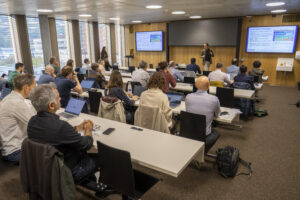
From 1 to 3 October, the STOR-HY partners gathered in Sion, Switzerland, for the project’s third consortium meeting, which was hosted by the HES-SO Valais-Wallis School of Engineering. The meeting coincided with the project’s first anniversary, marking a year of progress and close collaboration.
Work package updates
Each Work Package (WP) leader presented an update on their work since the previous consortium meeting in May. The UPC, leader of WP1, provided an overview of the project’s status, including the visits to the EDF demonstrators and the testing plans for the EDP demonstrators (Alqueva and Vilarinho). The following work was performed on the EDF demonstrators:
- Modal analysis at Vouglans/Saut-Mortier by the UPC
- Installation of the turbidity sensor at Le Cheylas by Andritz
- Installation of the monitoring system at Le Cheylas by the UPC
- Installation of turbidity and sediment sensors at La Rance by Andritz and EDF
The project coordinator, Alexandre Presas, also introduced the Gender Assessment Team, which monitors the implementation of the Gender Action Plan and held its first meeting in September. A gender balance survey was sent to all partners to collect data on the gender identity of project participants, which will be used to establish KPIs.
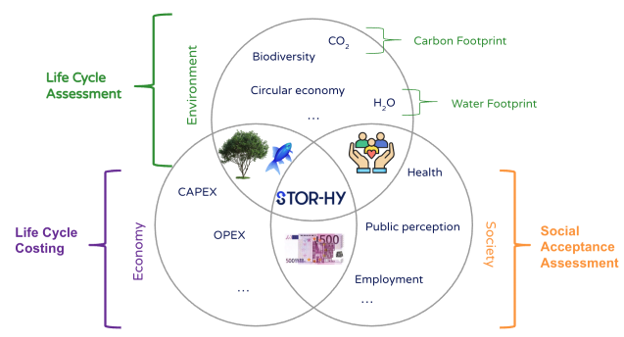
For WP2, INESCTEC, UT, and NORCE presented the techno-economic-regulatory, environmental, and societal dimensions that had been discussed during the “Identification of New Hydropower Requirements in a Context of Climate Change and RES-powered System” workshop in July.
Updates for WP3 included an overview of the Cyber-physical clone for Advance Decision Support (CADS), the installation of the aforementioned sensors and monitoring systems in the EDF demonstrators. Andritz explained that there were some issues with the sediment measurements, because the values were very low. PSP equipment at the Vouglans-Saut-Mortier-Coiselet (VSMC), Le Cheylas, and Alqueva demonstrators has been modelled.
In the WP4 presentation, partners presented their progress on back-to-back starting to achieve grid synchronisation and energy management of hydropower hybridised with battery energy storage systems and photovoltaics in Alqueva. The WP5 partners explained how they are enhancing the durability of PSP equipment in harsh operating conditions and saltwater environments, including biofouling, technical coatings, and sediment measurement.
As part of WP6, FAEN, HUNOSA, and SADIM provided updates on the location, size, and cost analysis of the Pozu Figaredo demonstrator, while EDP NEW presented the Demo Management Board. Other partners provided updates on the rest of the demonstrators.
UT presented the results of the Life Cycle Assessment (LCA) at La Rance, while NORCE gave a presentation on tracking social acceptance of hydropower through media discourse (WP7). vgbe presented the exploitation master plan methodology for market uptake and post-project exploitation (WP8), while Zabala highlighted the project’s communication and dissemination activities, including event attendance and social media statistics.
Visit to HES-SO labs
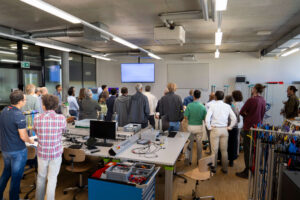
The consortium had the opportunity to attend a demonstration on inertia-less microgrids at the HES-SO Gridlab and visited the Hydro Alps Lab, which focuses on projects in the field of monitoring and improving alpine high-pressure and run-of-river power plants, including condition monitoring, digital clones, and digitalisation.
Public seminar
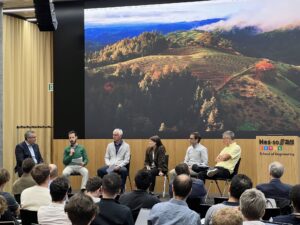
STOR-HY organised a public seminar entitled “Harnessing Hydropower’s Energy Storage and Flexibility for the Energy Transition”, featuring both internal and external speakers. Fabrizio Sossan, who hosted this consortium meeting, introduced the role of energy storage in future power systems. Two representatives of Swiss energy companies were among the speakers. Bernard Valluy from Alpiq discussed the role of hydropower innovation in the European electrical system, and Daniel Fischlin gave a presentation on the transformation of energy companies from energy producers to grid stabilisers.
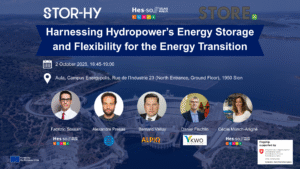
Alexandre Presas presented the STOR-HY project, and Cécile Münch-Alligné from HES-SO explained how numerical simulations are shaping the future of hydropower, including the challenges of hydraulic short circuits and sediment erosion.
The event concluded with an industrial roundtable with representatives of the project partners: António Aires de Matos (EDP), Jérôme Auguste (EDF), Magdalena Neuhauser (ANDRITZ), Patrick Boissonneau (GE Vernova), and Ricard Subirà (Sener).