STOR-HY continues to contribute to cutting-edge research at the intersection of artificial intelligence and hydropower digitalisation. A new scientific paper by KAIZEN Solutions has been accepted for presentation at the 2026 International Conference on Pattern Recognition (ICPR), one of the world’s leading conferences in computer vision and pattern recognition that will take place in Lyon, France, from 17 to 22 August 2026.
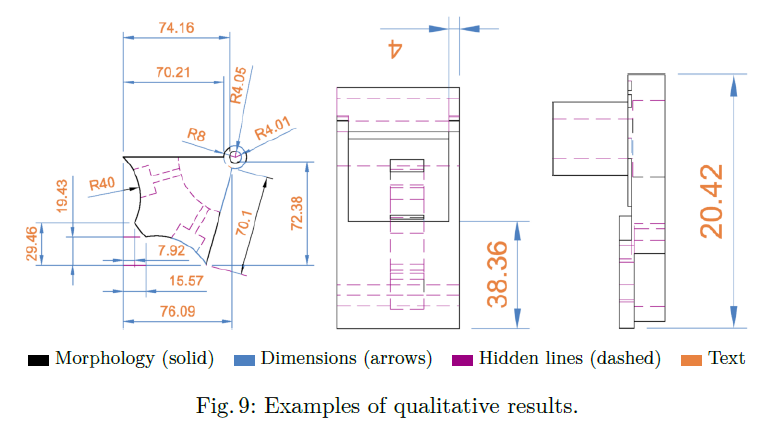
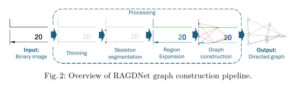
Entitled “RAGDNet: A Region-Adjacency Graph for Semantic Segmentation of Mechanical Drawings Using Graph Neural Networks”, the paper was written by Alexandre Monnier, Nicolas Hili, and Yann Ledru. It introduces a novel artificial intelligence approach that improves the interpretation of complex mechanical drawings by combining region-adjacency graphs (RAGs) with graph neural networks (GNNs).
Making engineering drawings understandable for AI
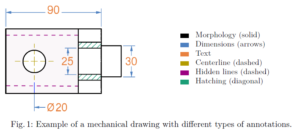
Technical drawings remain an essential source of information throughout the lifecycle of industrial infrastructure. However, many historical engineering assets, including hydropower plants, still rely on paper documentation that is difficult and time-consuming to analyse and compare with modern digital models.
The research addresses this challenge by developing an AI model capable of automatically identifying and classifying the different elements of mechanical drawings. Rather than treating a drawing as a conventional image, the proposed method represents it as a graph, allowing the model to better capture the relationships between neighbouring components. This enables a more accurate semantic interpretation while requiring fewer computational resources than many state-of-the-art approaches based on vision transformers.
Supporting the digitalisation of hydropower
Within STOR-HY, digitalisation plays a central role in improving the operation, monitoring, and maintenance of pumped storage hydropower plants. AI-based tools capable of understanding technical documentation can help engineers access and interpret legacy information more efficiently, facilitating the comparison between historical drawings and current digital models.
These capabilities support the broader objectives of the project by enabling smarter engineering workflows and contributing to the development of advanced digital tools for hydropower infrastructure.
From research to real-world applications
The acceptance of this paper at ICPR 2026 highlights the scientific excellence of the work being carried out within the STOR-HY consortium. By combining advances in artificial intelligence with practical industrial challenges, the research contributes to the development of innovative digital solutions that can improve the management of critical energy infrastructure.
You can read the full paper here.